An online conference titled “Artificial Intelligence and China’s Global Influence,” co-organized by the Institut Barcelona d’Estudis Internacionals (IBEI) and the Institute for AI International Governance (I-AIIG) at Tsinghua University, took place on April 17, 2026. The event gathered international scholars to discuss China’s AI strategy and its implications for global technological development, governance, and cooperation.
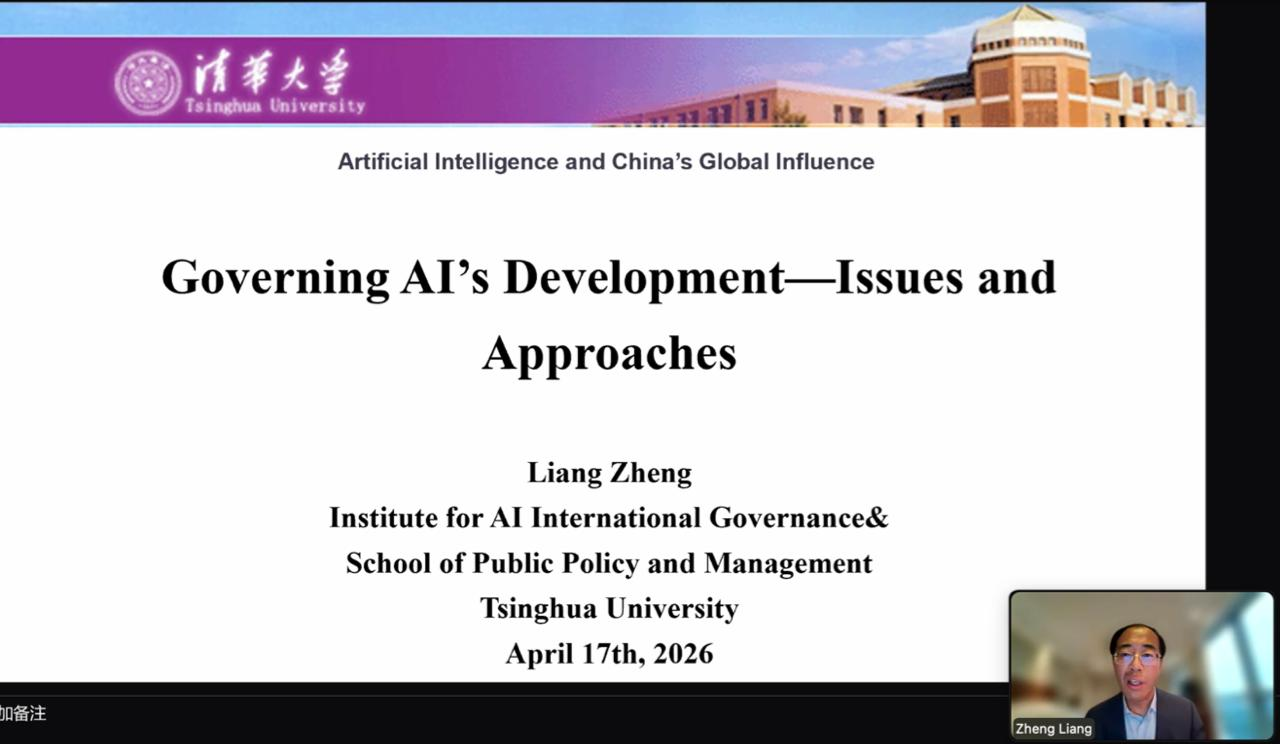
Professor Liang Zheng, Vice Dean of I-AIIG, delivered a keynote speech outlining China’s overall framework for AI governance and development. He noted that the country’s approach has moved toward a more institutionalized, scenario-based, and systematic model that balances innovation and safety. “AI governance requires a dynamic balance between development and risk prevention,” he said, highlighting the role of data security, algorithm regulation, and ethical standards in shaping a comprehensive governance system.

During the discussions, Professor Liang exchanged views with international experts on global AI governance frameworks, open-source ecosystems, risk management, and China-Europe cooperation on standards and regulatory approaches. He emphasized that open-source development can promote inclusive innovation and global collaboration, but it also requires stronger governance capacities. On China-Europe cooperation, he noted that both sides are highly complementary in areas such as autonomous driving and healthcare, and called for strengthened dialogue on standards and governance practices.
Professor Liang also shared insights on the impact of AI on employment structures, youth skill development, and global talent mobility.
Click to watch the full conference