On April 30, a group of leading scholars from the United States and China issued a joint warning at a public meeting on Capitol Hill, Washington D.C. about the potential existential AI risks, calling for stronger international cooperation to address what they described as a shared global challenge.
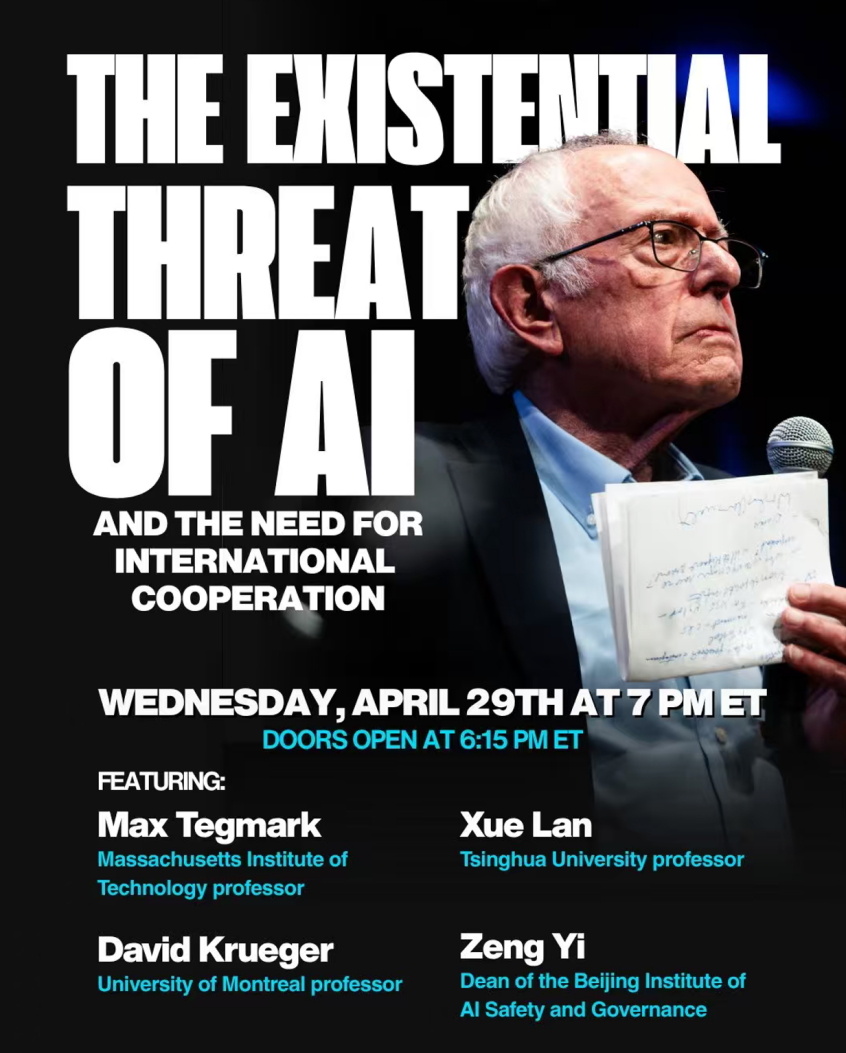
The event, titled “Existential Risks of Artificial Intelligence and International Cooperation,” was convened and chaired by Senator Bernie Sanders. Speakers included Xue Lan, Dean of Tsinghua University’s Institute for AI International Governance (I-AIIG); Max Tegmark, a Professor at the Massachusetts Institute of Technology and Founder of the Future of Life Institute; Zeng Yi, President of the Beijing Institute for AI Safety and Governance; and David Krueger, an Assistant Professor at the University of Montreal.
Despite differing academic backgrounds, the four experts converged on several key points. They argued that the risk of advanced AI systems becoming uncontrollable is not a distant science-fiction scenario but a plausible outcome if left unaddressed. They also warned that current assessments may underestimate these risks, while governance responses remain insufficient. Crucially, participants emphasized that AI governance transcends geopolitical rivalry and should be treated as a global public good, drawing parallels to nuclear arms control efforts during the Cold War.
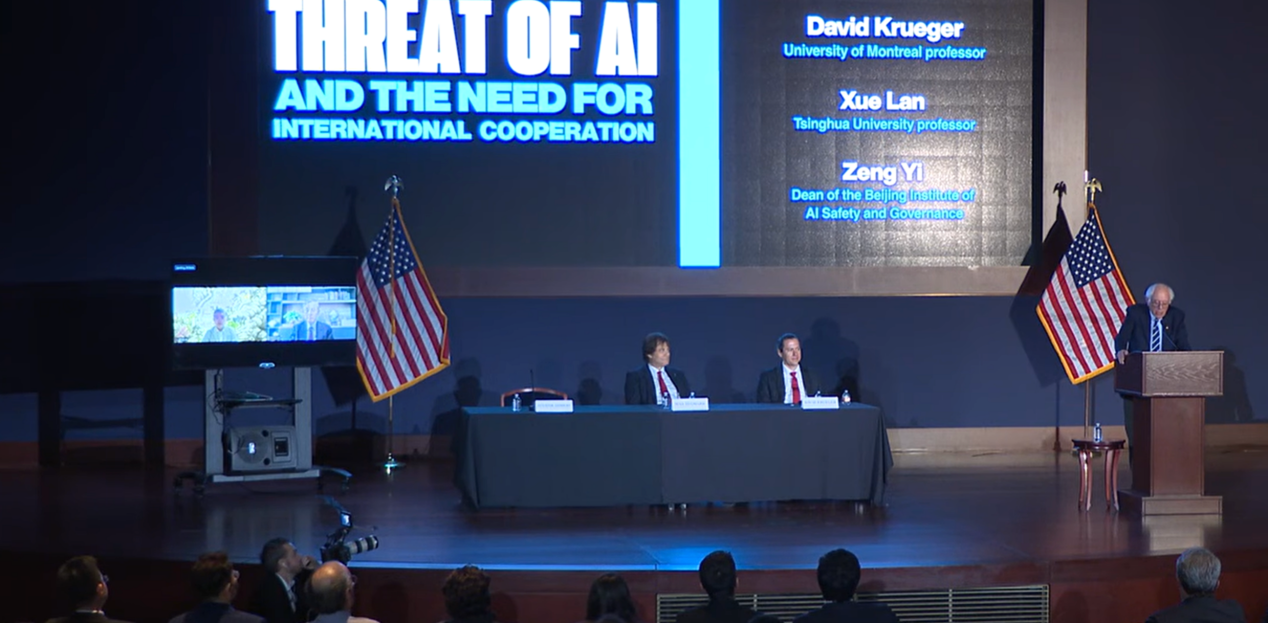
Xue outlined China’s approach to AI governance, describing a “dual-track” model that combines agile, adaptive regulation. He said the framework emphasizes rapid iteration and cooperation between government and industry, rather than adversarial oversight. According to Xue, China has pursued a “learning-by-doing” strategy—starting with high-level principles, then foundational regulations, and finally more targeted rules as technologies evolve—to balance innovation with safety.
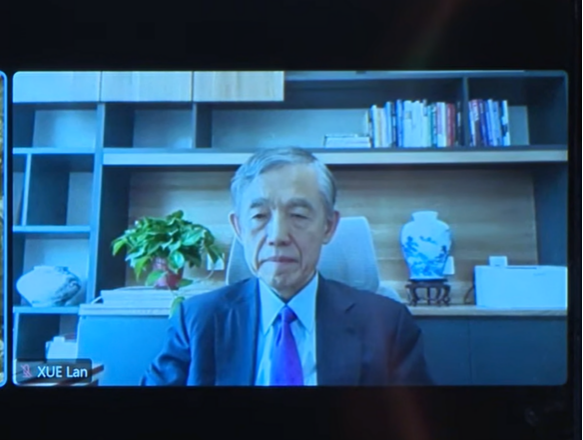
On international cooperation, Xue argued that the real competition is not between countries, but over who can develop the most capable and safest AI systems. He proposed establishing “safe zones” for collaboration between the United States and China, where researchers could work together on AI safety technologies, mutual recognition of standards, interoperability protocols, and shared risk monitoring systems. He also called for joint efforts to support developing countries and reduce the global “AI divide.”
In closing remarks, Sanders said that citizens in the United States, China, and around the world expect governments to work together to mitigate the potentially catastrophic risks posed by AI. He stressed that only through sustained international cooperation can innovation and safety be balanced, and humanity’s long-term future be safeguarded.
The meeting underscored a rare alignment between Chinese and American scholars, highlighting a shared willingness to build consensus through dialogue and advance global AI governance.