On July 18, 2026, the Closed-Door Evening Dialogue on “Frontier AI Safety and Critical Infrastructure : Evaluation, Standards and Cooperation” was successfully held at the Shanghai West Bund International Convention and Exhibition Center during the World Artificial Intelligence Conference (WAIC) 2026. The workshop was organized by the China AI Safety and Development Association (CnAISDA) and co-hosted by the Academy of Contemporary China and World Studies, the Center for International Security and Strategy at Tsinghua University, the Institute for Interdisciplinary Information Sciences at Tsinghua University, and the Institute for AI International Governance at Tsinghua University.
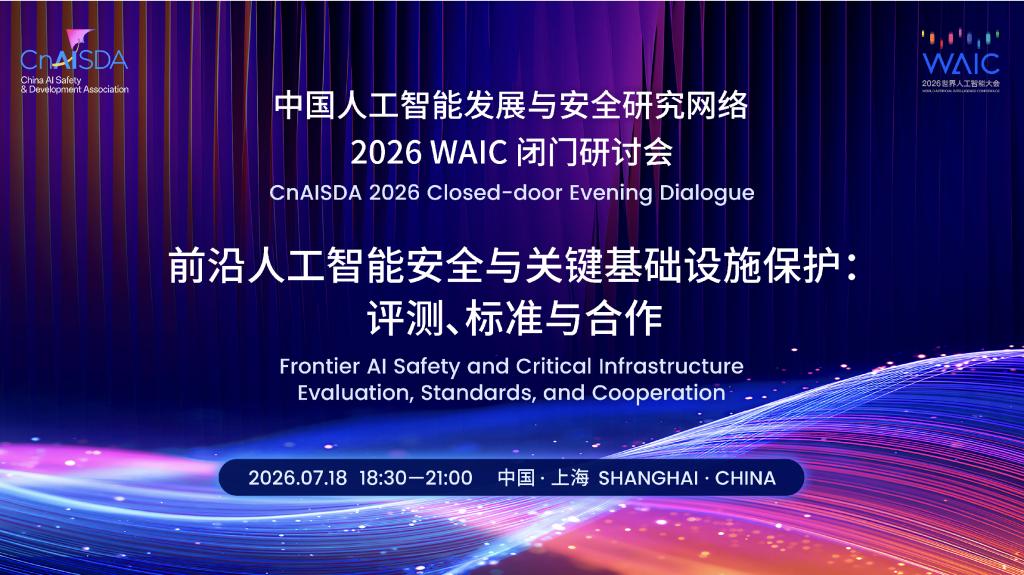
With the rapid evolution of frontier AI models, developing methodologies for assessing their potential risks, establishing mechanisms for the international recognition of safety standards, and building cross-border cooperation frameworks have become central issues in global AI governance. The workshop featured closed-door discussions on key topics, including frontier AI risk assessment, the development of safety standards, and pathways for international cooperation.
Turing Award laureate, Dean of the School of Artificial Intelligence at Tsinghua University, and Director of the Institute for Interdisciplinary Information Sciences (IIIS) at Tsinghua University, Andrew Chi-Chih Yao, delivered the opening remarks and introduced the latest progress made by the Tsinghua team in safety evaluation benchmarks and automated frontier AI evaluation. Andrew Chi-Chih Yao, noted that frontier AI currently faces three major categories of risks: misuse, long-horizon loss of control, and cognitive erosion. He emphasized that AI safety cannot be achieved through isolation, but rather through open methodologies, shared standards, and reproducible evaluations that build trust.
During the keynote session, Professor Xue Lan, Dean of the Institute for AI International Governance at Tsinghua University and Distinguished Professor of Liberal Arts at Tsinghua University; Professor Xu Wei, Deputy Director of the Institute for Interdisciplinary Information Sciences (IIIS) at Tsinghua University; and Dr. Xu Jia, Researcher at the Shanghai Artificial Intelligence Laboratory, delivered presentations on national AI capability assessment, AI safety benchmarking, and the Safety Capability Maturity Model (SCMM) for artificial intelligence, respectively. From the perspectives of evaluation, standards, and cooperation, they provided a systematic overview of the current state of AI development, as well as the challenges and issues facing the field.
During the open discussion session, participants focused on key topics including evaluation methodologies and governance approaches, mutual recognition of standards and international cooperation, as well as the positioning and role of AI safety research institutions.
The workshop brought together more than 70 Chinese and international participants, including experts and scholars in artificial intelligence technology, law, and governance policy from leading universities, think tanks, enterprises, and research institutions in China and abroad, as well as members of WAIC delegations from the United Kingdom, the Netherlands, the United States, Singapore, South Korea, India, and other countries, along with science and technology officials from foreign embassies in China.
The China AI Safety and Development Association (CnAISDA) will continue to advance research on frontier AI safety evaluation, promote the development of safety standards, and facilitate international dialogue. Representing China, CnAISDA will further strengthen exchanges and cooperation with AI safety research institutions around the world, contributing to global AI safety governance.
The China AI Safety and Development Association (CnAISDA) was officially launched in February 2025 during the Artificial Intelligence Action Summit in Paris. Initiated jointly by leading Chinese universities, research institutions, and think tanks, including Tsinghua University, Peking University, Beijing Academy of Artificial Intelligence (BAAI), Shanghai Artificial Intelligence Laboratory, Shanghai Qi Zhi Institute, the Institute of Automation of the Chinese Academy of Sciences, the China Academy of Information and Communications Technology (CAICT), and the China Center for Information Industry Development (CCID), CnAISDA is a collaborative network that brings together China’s leading resources and expert communities in the fields of AI development and safety. It serves as a platform for dialogue and cooperation between China and AI safety research institutions worldwide, contributing to the advancement of AI that is safe, reliable, and controllable.
Written by Zhao Zetong
Reviewed by Dong Ting, Qian Jiatong