On June 14, Tsinghua University hosted a dialogue at the School of Public Policy and Management (SPPM) featuring Zack Kass, OpenAI former Head of Go-To-Market and a leading global AI advisor. The event, titled “The Next RenAIssance: AI and the Expansion of Human Potential,” brought together scholars, students, alumni, and industry representatives to explore the societal implications of AI and its impacts on governance, innovation, ethics, and education.
The event was co-organized by the Center for Science and Technology Development and Governance (THUSTDG)and the Institute for AI International Governance (I-AIIG) at Tsinghua University, with support from the AI Universe Global Development Association.
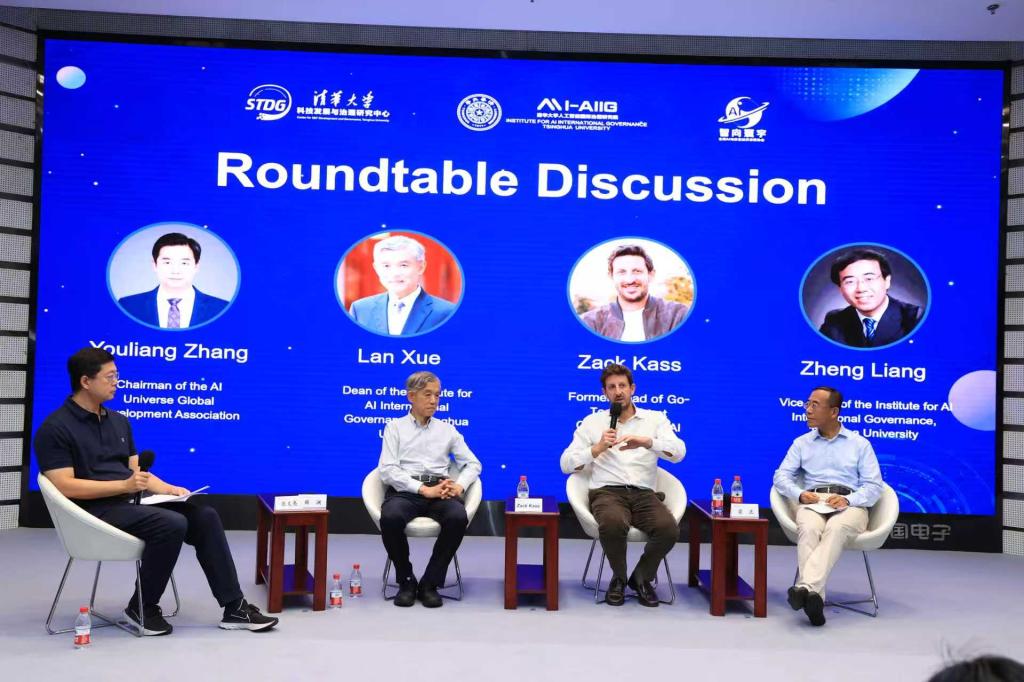
Xue Lan, Distinguished Professor of Arts, Humanities and Social Sciences, Dean of Schwarzman College, and Dean of I-AIIG at Tsinghua University; and Liang Zheng, Professor at SPPM and Vice Dean of I-AIIG, participated in a roundtable discussion with Kass. Zhu Xufeng, Professor and Dean of SPPM, and Director of THUSTDG, presided over the opening ceremony. Zhang Youliang, Chairman of the AI Universe Global Development Association, moderated the roundtable session. Nearly 200 guests, alumni, faculty, and students attended the event, including Hu Xiaofang, Vice Chair of the Beijing Science and Education Development Foundation; Xiao Qian, Vice Dean of I-AIIG; Chen Tianhao, Associate Professor at SPPM and Assistant Director of THUSTDG; and Meng Ke, Associate Professor at SPPM.
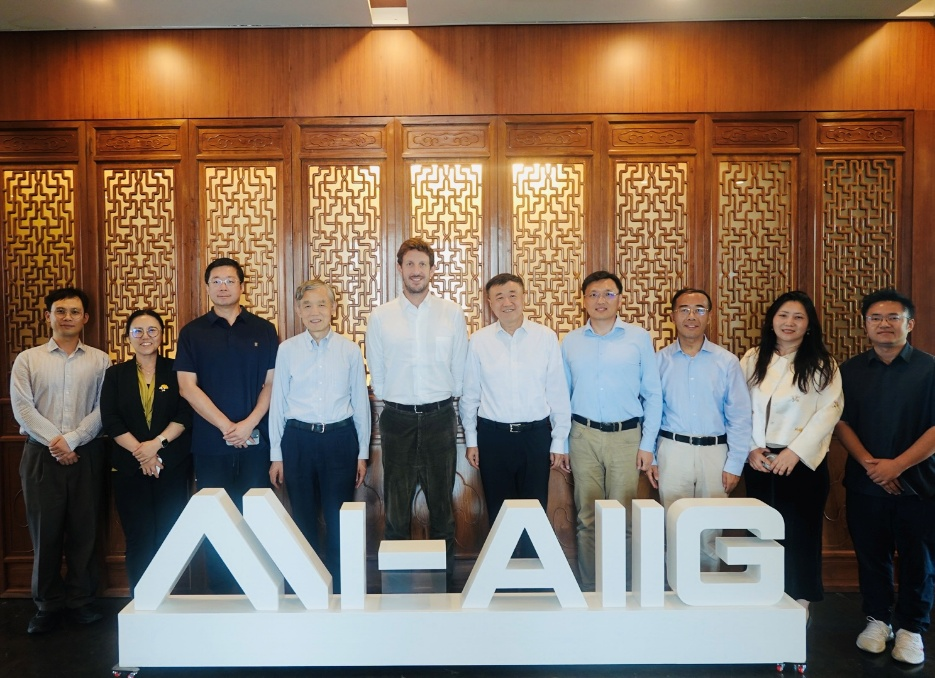
Following the event, Kass and the visiting delegation visited I-AIIG at Tsinghua University. Professor Yang Bin, Vice Chancellor of the Tsinghua University Council, Chair of the Governing Board, I-AIIG and Professor at the School of Economics and Management, met with the delegation and exchanged views on AI development and governance.
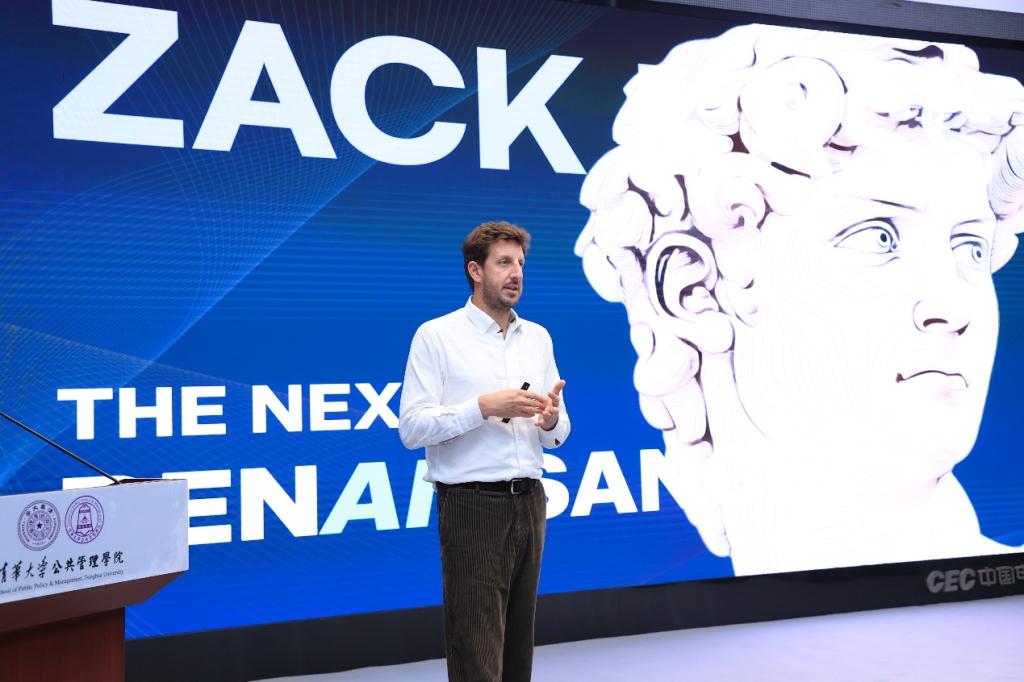
The opening session was chaired by Professor Zhu XufengHe emphasized that AI has evolved beyond a purely technological issue and is increasingly reshaping economies, governance systems, education, and social structures. He noted that as AI technologies enter new stages of commercialization and deployment, questions about governance, ethics, public policy, and human development have become more pressing than ever.
In his keynote address, Kass reflected on the relationship between AI and human potential from the perspectives of technological evolution, economic transformation, and societal change. Drawing on more than a decade of experience at the forefront of AI, he argued that the most significant development is not merely the rapid improvement of model capabilities but the continuous decline in the cost of intelligence itself.
Kass described this trend as the emergence of “unmetered intelligence,” suggesting that intelligence may increasingly become a broadly accessible resource, much like electricity or the internet. He emphasized that AI will not automatically make everyone exceptional; rather, it will give people greater access to capabilities that were once out of reach. The ultimate outcomes, he argued, will depend on how individuals, organizations, and societies choose to use these new tools.
Addressing concerns about AI risk, Kass highlighted challenges such as cognitive dependency, digital addiction, dehumanization, malicious online behavior, and identity disruptions stemming from changes in the nature of work. At the same time, he expressed optimism about AI’s capacity to accelerate breakthroughs in fields such as life sciences, materials science, energy, and healthcare, while lowering the cost of products and services and expanding access to opportunity.
The roundtable discussion explored the future trajectory of AI development, the integration of digital intelligence into real-world systems, AI ethics and human values, and the implications of AI for education and future generations.
Kass argued that over the next decade, AI is likely to experience its most transformative impact in two areas: accelerating scientific discovery and reducing the cost of goods and services. He also suggested that AI will move beyond visible interfaces and become increasingly embedded within workflows, public services, and everyday life as a form of “ambient intelligence.”
Professor Xue remarked that societies should not passively accept technological change driven solely by markets or technological capabilities. Instead, governance should help answer a more fundamental question: what kind of future does humanity seek to create with AI? In his view, effective governance does not constrain innovation but enables it to be more responsibly integrated into society. He called for more agile, adaptive, and participatory governance approaches for keeping pace with rapid technological development.
Professor Liang noted that many existing governance frameworks were designed for the industrial era and are ill-suited to intelligent systems in the physical world, including autonomous vehicles, smart homes, and AI agents. He stressed the importance of rethinking responsibility, risk allocation, and institutional adaptation, while also ensuring that perspectives from the Global South are adequately represented in international AI governance discussions.
The panel also discussed the future of education in the AI era. Kass highlighted the importance of cultivating curiosity, moral judgment, and human agency among younger generations. Professor Liang argued that education should help students better understand themselves, others, and real-world needs, while fostering creativity and critical thinking. Professor Xue called for deeper reflection on disciplinary structures, talent development models, and systems of social recognition in higher education, advocating for more open and interdisciplinary learning ecosystems.
The discussion concluded with an audience Q&A session covering topics such as digital life among young people, platform responsibility, the reconstruction of public spaces, international competition in developing AI, and the growth of open-source models.Participants noted that the dialogue provided valuable insights into the latest developments in AI and highlighted broader societal questions raised by AI from the perspectives of public policy and technology governance, contributing to ongoing discussions on responsible AI development and international cooperation.