On the afternoon of June 18, 2026, the Institute for AI International Governance (I-AIIG) at Tsinghua University hosted the tenth episode of its “AI International Governance Forum” as an online session. This lecture also marked the first installment of the Laureate Lecture Series for the UNESCO–Uzbekistan Beruniy Prize for Scientific Research on the Ethics of Artificial Intelligence (hereinafter referred to as the “Beruniy Prize”), to foster academic exchange among recipients and advance global dialogue on AI ethics.

The session was held via Zoom and included a Q&A segment. I-AIIG’s Dean, Professor Xue Lan, delivered opening remarks, while Vice Dean, Professor Liang Zheng, moderated the event.
In his opening address, Professor Xue noted that the ethical protection of digitized testimonies of mass violence represents a pressing and intellectually frontier issue at the intersection of AI governance and human rights. He highlighted I-AIIG’s longstanding commitment to research on AI ethics, global governance, and international cooperation, and noted that I-AIIG’s recognition as a laureate of the inaugural Beruniy Prize reflects its contributions internationally. He hoped that the lecture would stimulate interdisciplinary dialogue and contribute to a more responsible digital governance framework, and he extended his appreciation to the two speakers for their participation in the event.
The two speakers included Professor Susan Perry, a human rights expert, and Professor Claudia Roda, a computer scientist, both from The American University of Paris and co-recipients of the 2025 Beruniy Prize. The specialists delivered a joint presentation on the ethical use and protection of digitized testimonies of victims and witnesses of mass violence.
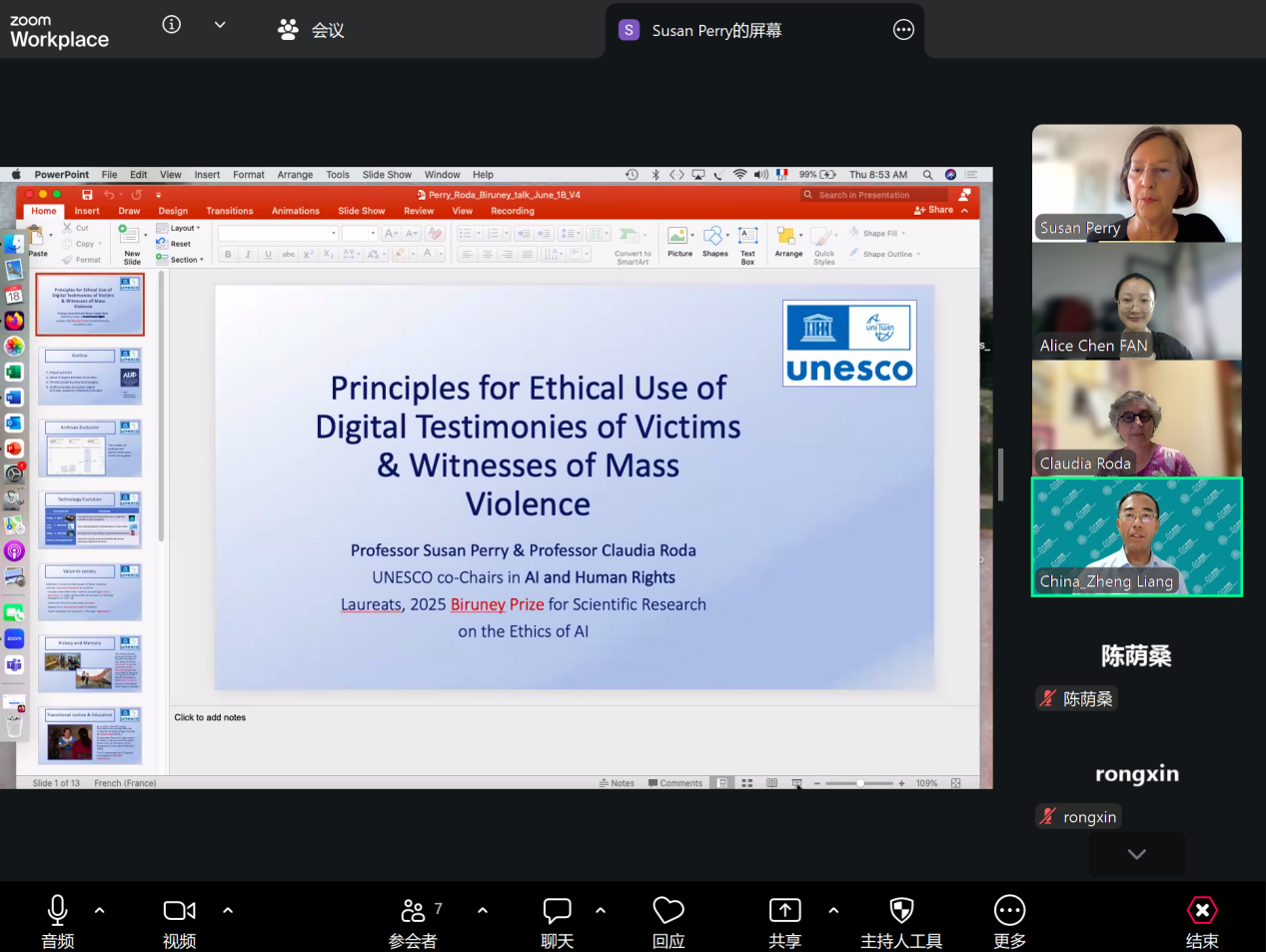
Both professors systematically presented their research findings and noted that digital archives play an increasingly significant role in historical research, the construction of social memory, transitional justice, and public education, citing the oral history archives established by institutions such as the USC Shoah Foundation.
At the same time, they cautioned that technological advances have brought considerable risks. Digital archives are transitioning from analog to digital formats, from local storage to cloud-based networking, and from human curation to AI-driven automation. While this has greatly enhanced accessibility, it has also exposed these archives to cyberattacks, data tampering, deepfakes, voice cloning, and algorithmic distortions. These threats give rise to the “liar’s dividend,” a proliferation of synthetic content that casts doubt on authentic records, paradoxically benefiting those who seek to deceive.
On the legal and governance front, the report examined the limitations of international law in protecting digitized testimonies. Existing international human rights law primarily safeguards the rights of living individuals, while international humanitarian law provides frameworks for the protection of remains and archives in specific conflict settings. However, neither adequately addresses the long-term governance needs of digital testimonies. Given that such testimonies often pertain to deceased victims, both professors argued for extending the principle of dignity to digital space, drawing inspiration from the spirit of protecting physical remains.
Drawing on the UNESCO Recommendation on the Ethics of Artificial Intelligence, the report proposed a preliminary ethical framework to protect digital testimonies. This framework addresses respect for human dignity, proportionality and non-maleficence, security, privacy and data protection, multi-stakeholder governance, accountability, transparency, fairness and non-discrimination, sustainability, and digital literacy.
In closing, the professors emphasized that protecting digitized testimonies is both a technical challenge and a long-term ethical responsibility for human dignity and the continuity of historical memory. While ensuring accessibility, they stressed the importance of upholding protective principles for vulnerable groups and historical witnesses and called for the construction of a more responsible global digital memory governance system.
During the interactive session, faculty members and students from Tsinghua University’s School of Public Policy and Management, Schwarzman College, The American University of Paris, and universities in Indonesia engaged in a discussion with the speakers. Questions included the attribution of long-term preservation responsibilities, how to distinguish AI-generated content from original archival materials, and the balance between open access and privacy protection. The speakers responded to each question with reference to specific cases, emphasizing that technological solutions and ethical norms must develop in tandem, and they encouraged more young scholars to engage in this interdisciplinary field.
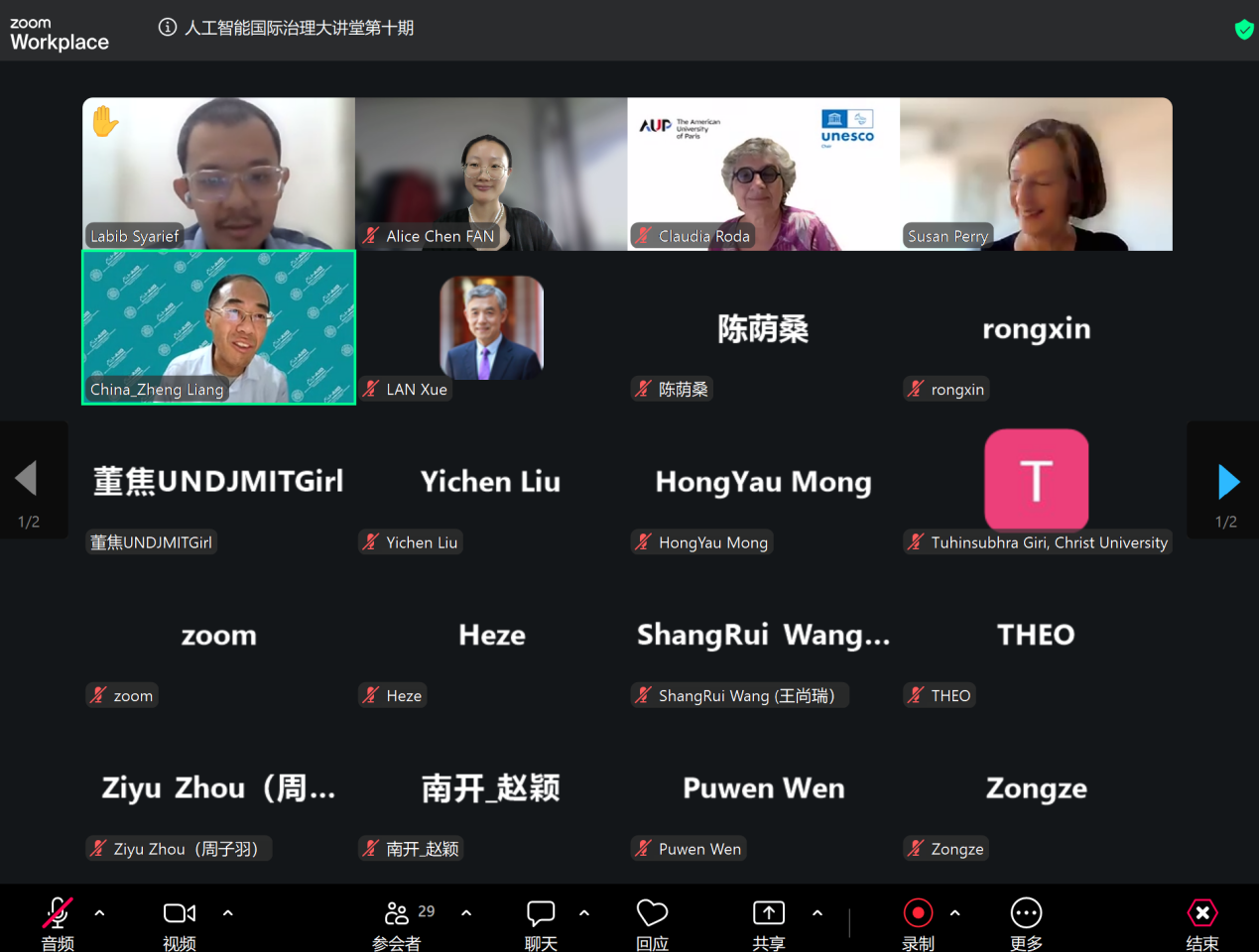
The lecture concluded with fruitful exchanges. I-AIIG will continue hosting the Beruniy Prize Laureate Lecture Series in the coming months. Stay tuned for upcoming sessions.