An official Digital@UNGA 2026 Affiliate Session, “Governing AI in the Real World: From Frontier Innovation to Global Action,” was held on September 23 during the 81st United Nations General Assembly (UNGA) in New York. Hosted at the United Nations University Centre for Policy Research (UNU-CPR), the session brought together experts from international organizations, academia, industry, and policy communities to examine how global AI governance principles can become practical, measurable, and actionable.
The session was organized by the Institute for AI International Governance (I-AIIG) of Tsinghua University, UNU-CPR, International Association for Safe & Ethical AI (IASEAI), UNU Hub on Promoting Ethical and Responsible Artificial Intelligence Development, UNU Global AI Network, AI Safety Connect (AISC), CAST UN Consultative Committee on Science Diplomacy (CCSD), and Chinese Association of Science of Science and Science &Technology Policy (CASSSP).
Before the session, a Tsinghua University delegation met with representatives from UNU-CPR to exchange views on institutional development, research priorities, global AI governance, and opportunities for future collaboration.
During the meeting, Yang Bin, Vice Chancellor of the Tsinghua University Council and Professor of Tsinghua University’s School of Economics and Management, presented a commemorative gift to UNU-CPR’s Chief Operations Officer, Christina McElwaine, who also moderated the session.

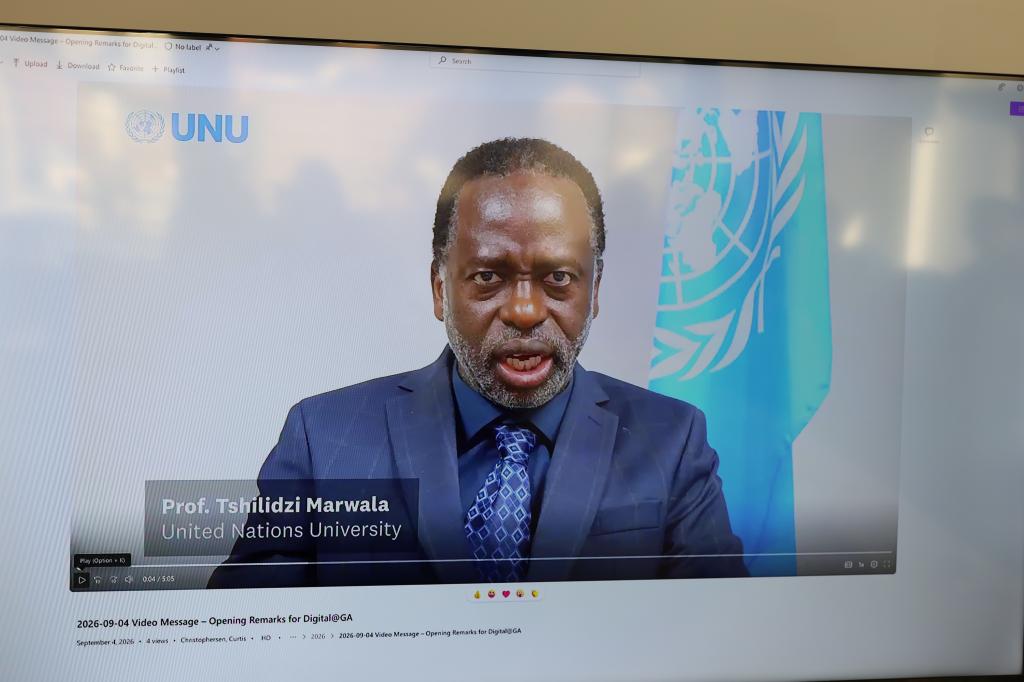
Yang Bin delivered opening remarks on behalf of Tsinghua University, followed by a video address from Tshilidzi Marwala, UNU Rector and UN Under-Secretary-General.
The session gathered a diverse group of leading experts and practitioners in AI governance, technology, international cooperation, and science diplomacy. Participants included Tshilidzi Marwala, UNU Rector and UN Under-Secretary-General; Lu Qinghua, Member of the UN Independent International Scientific Panel on AI and Group Leader of the Software Systems Research Group at the Commonwealth Scientific and Industrial Research Organisation (CSIRO); Stuart Russell, Professor of Computer Science at the University of California, Berkeley and President of IASEAI; Mark Nitzberg, Co-founder of IASEAI and Executive Director of the UC Berkeley Center for Human-Compatible Artificial Intelligence (CHAI); Mark Robinson, Senior Science Diplomacy Advisor at the Oxford Martin AI Governance Initiative; Emrys Schoemaker, Head of Digital and Frontier Technologies at UNU-CPR; and Cyrus Hodes, Founder of AI Safety Connect and Venture Partner of Lionheart Ventures. Additional participants included representatives from the Carnegie Endowment for International Peace, United Nations Development Programme (UNDP), the General Secretariat of the Cabinet of the UAE, the Machine Intelligence Research Institute (MIRI), ZTE Corporation, and the Centre for International Governance Innovation (CIGI), among others.

The opening remarks highlighted the rapid transition of frontier AI from research and development to real-world applications and the need to strengthen practical governance capabilities. Speakers emphasized the importance of translating governance principles into effective risk management, responsible deployment, measurable approaches, and international cooperation.
The first roundtable, “From Frontier AI Innovation to Responsible Deployment,” was moderated by Mark Nitzberg, Co-founder of IASEAI and Executive Director of CHAI.

The discussion focused on the governance capabilities needed as frontier AI systems move into increasingly varied real-world settings. Participants examined how to integrate AI readiness, risk and impact assessment, technical safeguards, and governance mechanisms into AI development and deployment rather than treating them as separate compliance requirements.

Speakers also shared perspectives from government, industry, academia, and international organizations on emerging approaches to responsible innovation, highlighting the importance of institutional capacity, technical expertise, and human oversight in managing the opportunities and risks of increasingly capable AI systems.
The second roundtable, “From Governance Principles to Measurable Action,” was moderated by Xiao Qian, Vice Dean of Tsinghua University’s I-AIIG.
Moving from deployment to institutional capacity, the discussion examined how countries and organizations can assess their AI governance readiness and capacity, identify gaps, and translate assessment findings into tangible priorities.
Participants discussed the roles of indicators, assessment methodologies, institutional mechanisms, capacity building, and evidence sharing in strengthening AI governance. They also considered how stakeholders with varying institutional capacities and regulatory approaches can cooperate on practical governance solutions while keeping those approaches adaptable to rapidly evolving AI technologies.
The two sessions formed an ongoing roundtable discussion, with over 40 participants joining online and in person from diverse regions and sectors. The exchange highlighted a shared need to transition from theory-based principles to governance approaches that can be implemented, evaluated, and continuously improved in practice.
Discussions throughout the session underscored the importance of developing practical tools for AI governance implementation, risk and impact assessment, institutional readiness, technical safeguards, and capacity building, while strengthening channels for international dialogue and cooperation.
Held during UNGA, the session provided stakeholders from academia, international organizations, industry, and policy communities with a platform to share experiences and explore practical pathways to advance the safe, trustworthy, and beneficial use of frontier AI.
The event concluded with a continued emphasis on turning global AI governance principles into concrete action and on strengthening international cooperation to address governance challenges arising from rapidly evolving AI technologies.