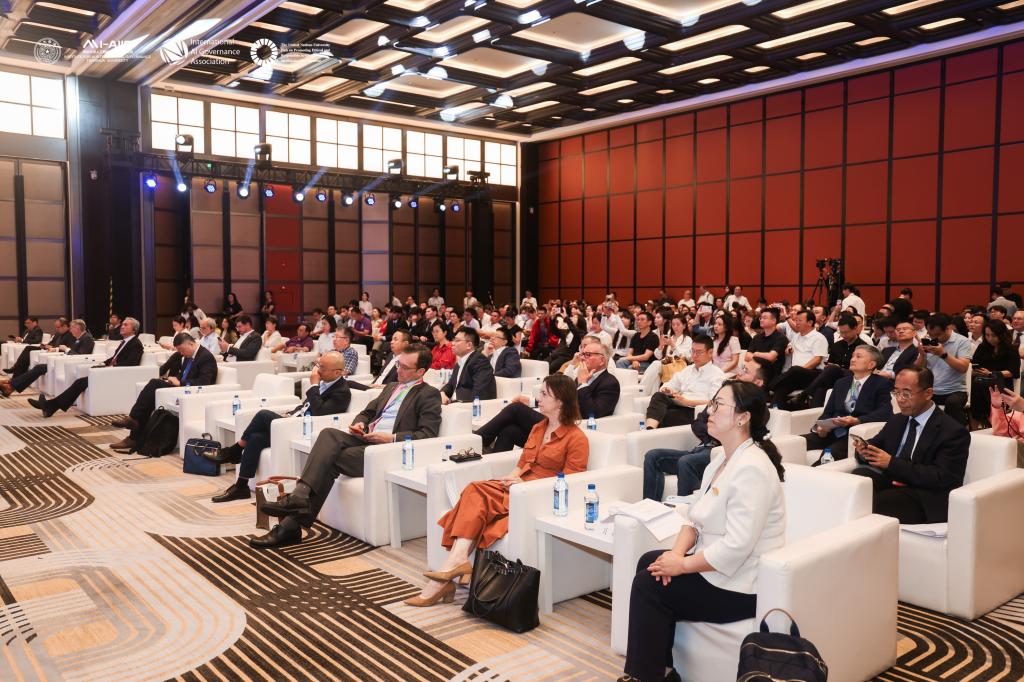
On July 18, 2026, more than 300 representatives from governments, United Nations (UN) agencies, academia, industry, and civil society convened at the 2026 World Artificial Intelligence Conference (WAIC) for the forum “From Consensus to Action: Possible Pathways for Global AI Governance” in Shanghai, China. Organized by Tsinghua University’s Institute for AI International Governance (I-AIIG), together with the International AI Governance Association (IAGA) and the UNU Hub for the Project of Promoting Ethical and Responsible Artificial Intelligence, the forum gathered leading international experts to explore how global AI governance can advance beyond shared principles towards practical implementation.
The forum was supported by the United Nations Development Programme China (UNDP China), the United Nations Children’s Fund in China (UNICEF China), the UNESCO Regional Office for East Asia, the United Nations University Institute in Macau (UNU Macau), the China Telecom Research Institute, and the CAST UN Consultative Committee on Science Diplomacy.
Held under the theme “From Consensus to Action: Possible Pathways for Global AI Governance,” the forum featured an opening session, a high-level dialogue, the launch of major research outputs, a keynote address, and two roundtable discussions. Participants exchanged views on emerging governance mechanisms within the United Nations Global Digital Compact, AI ethics and capacity-building, multi-stakeholder cooperation, and practical approaches to strengthening global AI governance. Several major research reports and governance initiatives were also unveiled during the event.
The forum occurred at a pivotal moment for international AI governance. Building on recent discussions, including the UN Global Dialogue on AI Governance and the establishment of the World Artificial Intelligence Cooperation Organization (WAICO), participants explored how international cooperation can move towards concrete governance frameworks, implementation mechanisms, and capacity-building initiatives that ensure AI development remains safe, inclusive, and beneficial for all.
Opening Session Highlights the Importance of International Cooperation
The opening session was moderated by Xiao Qian, Vice Dean of Tsinghua University’s I-AIIG.
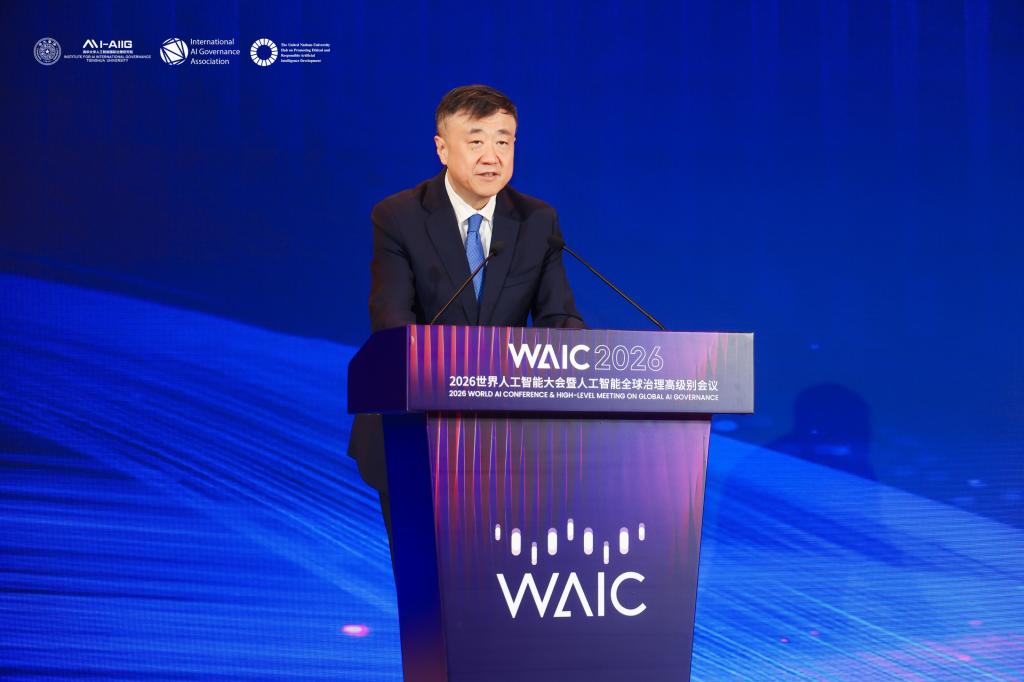
In his opening remarks, Yang Bin, Vice Chancellor of the Tsinghua University Council, welcomed the participants and reaffirmed Tsinghua’s commitment to advancing responsible AI development through education, interdisciplinary research, and international cooperation. He noted that while AI offers unprecedented opportunities for innovation and sustainable development, it also poses significant governance challenges that require collective global action. He highlighted Tsinghua’s ongoing initiatives to integrate AI across education, strengthen AI ethics research, promote international academic collaboration, and contribute to the development of national standards and governance frameworks.
Aya Suzuki, Senior Vice-Rector of UNU and Assistant Secretary-General of the UN, remarked that AI is transforming economies and societies at an exceptional pace, making international cooperation more important than ever. She noted that effective AI governance requires inclusive, evidence-based and human-centered collaboration among governments, international organizations, academia, industry, and civil society. She also recognized the contributions of I-AIIG and its UN partners in promoting AI ethics and responsible use, calling for stronger partnerships to translate shared principles into tangible action.
High-Level Dialogue Explores Pathways from Principles to Practice
This high-level dialogue, moderated by Xue Lan, Distinguished Professor of Arts, Humanities and Social Sciences and Dean of I-AIIG, convened leaders from international organizations, academia and industry to examine realistic pathways for advancing global AI governance.
Speakers included Nambaryn Enkhbayar, Third President of Mongolia and Governor of the New Kharkhorin Capital City Council; Xiong Yu, Fellow of the Academy of Social Sciences, Chair Professor of Business Analytics at the University of Surrey, and Director of the Surrey Academy for Blockchain and Metaverse Applications; Jason Slater, Chief AI, Innovation and Digital Officer of the United Nations Industrial Development Organization (UNIDO); Kaan Cetinturk, Chief Information Officer of UNICEF (joining virtually); John Higgins, Chairman of IAGA; and Shen Hao, Deputy Chief Engineer of the Shanghai Artificial Intelligence Research Institute.
Professor Xue opened the discussion by observing that the rapid advancement of AI is outpacing the world’s ability to govern it effectively. Citing the recent UN Global Dialogue on AI Governance and the inaugural report of the Independent International Scientific Panel on AI, he argued that the main challenge facing the international community is no longer whether AI should be governed, but how governance can be implemented in a practical and coordinated manner.
Throughout the dialogue, participants highlighted the importance of strengthening international cooperation, expanding AI capacity-building, improving interoperability across governance frameworks, and ensuring that technological innovation remains aligned with human values and sustainable development. Speakers also underlined the need to support developing countries in developing AI capabilities, establish internationally recognized standards, and foster broader participation from governments, industry, academia, and civil society in shaping the future of AI governance.
New Research and Governance Initiatives Unveiled
A major highlight of the forum was the launch of the World AI Capacity Index Report (Consultation Draft), presented by Professor Xue Lan.
The report proposes a new framework for assessing national AI capability by defining AI capacity as a country’s ability to translate computing resources, data, talent, and institutions into sustained economic and societal value. Rather than evaluating AI development and governance separately, the framework integrates both dimensions into a unified assessment model that covers knowledge creation, technology diffusion, value generation, strategic governance, regulatory capacity, and adaptive learning.
Drawing on multi-source data from 92 countries, the report identifies significant global disparities in AI capability, revealing that AI development continues to outpace governance in many countries, while regulatory institutions and participation in international standards remain unevenly distributed. The report also calls for greater interoperability among governance frameworks, stronger international cooperation, and enhanced capacity-sharing to narrow global AI governance gaps and promote more inclusive AI development.
The forum also showcased a series of new initiatives to strengthen evidence-based AI governance. Liang Zheng, Vice Dean of I-AIIG, introduced I-AIIG’s AI Application Scenarios Think Tank Research Series, which documents China’s AI implementation across the education, finance, government services and intelligent transportation sectors. Additional volumes on logistics, telecommunications, culture and tourism, energy and creative industries are in development.
Following the presentation of the assessment report, the forum released a series of research outputs and initiatives that reflect the growing focus on practical governance tools and international collaboration.
Professor Zhu Xufeng, Dean of the School of Public Policy and Management and Dean of the Center for Science & Technology Development and Governance at Tsinghua University, launched the Agent Safety Governance Framework (Version 1.0), which provides a structured framework for identifying emerging risks associated with AI agents and proposes governance measures for capability assessment, threat classification, and policy responses.
The forum also announced the 2026 Global Youth AI Future Innovation Competition, jointly organized by UNU and the Nordic Innovation Center, with I-AIIG serving as the exclusive academic partner. The competition aims to encourage young innovators worldwide to develop AI-driven solutions in education, social innovation, and sustainable development, particularly in the most underdeveloped countries.
Regarding AI safety, John Higgins, Chairman of IAGA; Yang Shichun, Director of the IAGA Automotive Committee; and Min Zhaoyuan, Deputy General Manager of China Merchants Testing and CEO of China Merchants Vehicle Research Institute, launched the Automobile Al Safety and Security Testing Assessment and Rating Programme, providing a systematic methodology for evaluating AI safety in intelligent driving, cockpit, control, and cloud-based automotive systems.
The forum also saw the release of AI Governance and Assurance Global Trends 2025–2026, presented by Rob Wortham, Executive Director of IAGA. The report outlines the latest developments in global AI governance policies, standards and regulatory frameworks. It concludes that global AI governance is shifting from high-level principles towards implementation and assurance, while emphasizing the importance of interoperability, international standards and cross-border cooperation.
Keynote Calls for Inclusive AI Development
In his keynote address, Alexander De Croo, Administrator of UNDP, stated the importance of ensuring that AI serves people and contributes to sustainable development.
Drawing on UNDP’s experience in developing countries, he argued that the success of AI should not be measured solely by technological breakthroughs, but by its ability to improve people’s lives through better healthcare, education, agricultural services, and access to reliable information. He stressed that AI should enhance human capabilities rather than replace them, enabling communities to benefit from technological progress regardless of geography or income level.
De Croo also noted that narrowing global disparities in AI readiness requires sustained investment in capacity-building, digital infrastructure, and institutional capabilities. He called for closer collaboration among governments, academia, industry, and international bodies to ensure that innovation, safety, and inclusion advance in tandem through multilateral cooperation.
Roundtables Focus on Global Coordination and China’s Contributions
The first roundtable, “Rules and Coordination — How Can International Organizations and Multi-Stakeholder Actors Jointly Advance Global AI Governance?”, was moderated by Xiao Qian, Vice Dean of I-AIIG.
The discussion featured Shahbaz Khan, Director of the UNESCO Regional Office for East Asia; Amanda Bissex, Deputy Representative of UNICEF China; Andrew Forrest AO, Founder of the Minderoo Foundation; Paul Triolo, Partner at DGA-Albright Stonebridge Group; and Rob Wortham, Executive Director of IAGA.
The participants explored how international bodies, governments, industry, philanthropic organizations, and research institutions can collaborate to strengthen AI governance. Discussions covered the need for interoperable governance frameworks, greater alignment of international standards, stronger AI capacity-building in developing countries, and more inclusive participation in global rule-making. Speakers agreed that effective AI governance depends on a combination of regulatory frameworks, international cooperation, knowledge sharing, and trust among stakeholders.
The second roundtable, “AI Governance in Practice — How Can China Contribute to Global AI Governance?”, was moderated by Liang Zheng, Vice Dean of I-AIIG.
Panelists included Zhu Xufeng; Zhang Jian, Deputy Dean of the Institute of Climate Change and Sustainable Development at Tsinghua University; Zhang Chao, Associate Professor in the Department of Electronic Engineering at Tsinghua University; Gan Bin, Vice President and Director of Standardization and Industry Development Dept, Huawei Technologies Co., Ltd; and Fan Hailong, General Manager of the Electronic Information Business Division at China Merchants Testing Vehicle Technology Research Institute Co., Ltd.
The discussion examined China’s experience in advancing responsible AI governance across public policy, industrial use, and technological innovation. Topics included governance frameworks for AI agents, responsible AI operations in industry, green AI and sustainable development, AI safety technologies, and governance approaches for intelligent connected vehicles. The participants stated the importance of balancing innovation with safety while contributing useful governance experience and technical expertise to international cooperation.
Looking Ahead
This year’s forum marks the fourth consecutive year I-AIIG has organized a dedicated forum at WAIC. More than 300 participants attended in person, while the event attracted over 150,000 online views, making it I-AIIG’s largest and most successful WAIC forum to date.
Held shortly after the inaugural UN Global Dialogue on AI Governance and alongside the establishment of WAICO, the forum reflected a growing international sentiment towards translating shared principles into practical governance. Through policy dialogue, evidence-based research and multi-stakeholder collaboration, participants reaffirmed that effective AI governance will depend on sustained international cooperation, greater institutional capacity, and more interoperable governance frameworks. The forum also reinforced I-AIIG’s role as a leading international platform for advancing dialogue, research and cooperation on global AI governance, while contributing to the development of AI that is safe, trustworthy, inclusive and beneficial for all.