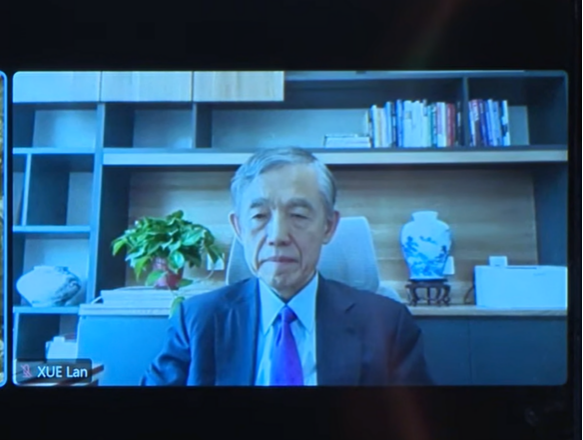
On April 30, a group of leading scholars from the United States and China issued a joint warning at a public meeting on Capitol Hill, Washington D.C. about the potential existential AI risks, calling for stronger international cooperation to address what they described as a shared global challenge. The event, titled “Existential Risks of Artificial Intelligence and International Cooperation,” was convened and chaired by Senator Bernie Sanders. Speakers included Xue Lan, Dean of Tsinghua University’s Institute for AI International Governance (I-AIIG); Max Tegmark, a Professor at the Massachusetts Institute of Technology and Founder of the Future of Life Institute; Zeng Yi, President of the Beijing Institute for AI Safety and Governance; and David Krueger, an Assistant Professor at the University of Montreal.
Transcript of AI Scientist Panel (Q &A of Senator Sanders and Lan Xue)
Senator Sanders: Dr. Xue, the international community has come together to try and prevent nuclear war. The global community has come together to address pandemics that have killed millions of people. In your judgment, has the international community come together to address the threat posed by AI?
==============================
Lan Xue: Thank you, Mr. Senator. I want to thank you for inviting me to this panel. As someone who has been a student of S&T policy for his whole life, I see AI’s development as a transformative change that we must try our best to learn how to embrace. So, I am grateful for having this opportunity to learn and to share with other colleagues.
International community has been trying but so far, not enough and not very effective. there are various multilateral mechanisms such as AI summit meetings started in 2023 in UK and this year in Delhi; There are various UN mechanisms such as the scientific panel and the multilateral dialogue to be held in July; There are also many other regional and bilateral initiatives.
But these efforts are fragmented and not as effective as they should be. There are several reasons for this situation—the first one is the uncertainty involved in AI risks—people may not be able to see the AI risks ahead and may not understand their behaviors. The second one is the so called pacing problem. AI technological change moves much faster than governance changes; The third one is that the geopolitical situation makes it hard for major AI countries to come together to design effective mechanism to build guiderail against AI risks.
Senator Sanders: Let us now turn to what can be done. Dr. Xue, what is China doing to regulate the risks presented by AI?
=====================================
Lan Xue: China’s overall approach is trying to balance between innovation and safety. This is implemented through an agile and adaptive way. First of all, on Agile governance, given that regulation and policy are always slower than the technology, you have to give up the idea that you want to be accurate and comprehensive all the time, but try to act quickly even though you may still have some holes here and there. You can update later anyway. The second is for the government and companies to stop playing the game of cat and mouse, but try to work together to address AI risks. The third piece of Agile governance is to avoid using heavy punishment when nudge may work, except for clear danger to public interests.
Second, on adaptive governance, China did not have to ambition to develop an overarching governance in a single stroke, but taking a learning by doing approach. First, China has developed a set of governance principles to provide guidelines; It later developed some foundational legislations that provided legal framework for AI system to operate in—including personal information protection law, data security law, and cybersecurity law and etc. China also came out various regulations in response to the new advances in AI. For example, in response to Large Language Models, China came up “Temporary Measures for the management of generative AI services”. These regulations are updated from time to time to adapt to the new technologies. Chinese companies have also developed voluntary commitments for safe practice (for example, in 2025 WAIC, leading Chinese AI companies signed up to an updated commitments).
Adding all these elements together, China has built a multi-layered system to regulates AI risks, it still has weaknesses and problems, but it has been able to support China’s AI development in a balanced way.
Senator Sanders: Dr. Xue, in a previous lecture, you previously called geopolitical rivalry “the big elephant in the room that people do not necessarily want to talk about.” Let’s talk about it. How can China, the US, and other countries come together to promote international cooperation around AI?
Lan Xue: First, we have to change the inaccurate narrative that US and China are engaged in an AI race. At the moment, many leading companies are US and Chinese companies, but disruptive innovation can change the landscape entirely, so it is quite possible that years later there might be companies and models from other countries. So, the ultimate race is among global companies on who can provide better performing models and services while minimizing the risks to society.
Second, mindful of the geopolitical rivalry, let’s find areas that US and China would have mutual interests in, which is guardrail against AI risks. If one country is not safe, all of us are not safe. So, AI safety is an area that US China can collaborate on-developing safety standards, safety technologies, protocols for emergencies, and so on.
Third, US and China can work together to promote capacity building in global community aimed at reducing AI divide. It is unimaginable to think of a world with only a few countries and a few companies to have the most powerful tools but the rest of the world is impoverished with nothing. That kind of scenario is frightening! So, I think US and China should have common interest to work together to bridge the AI divide not only for the developing world, but also for ourselves.